
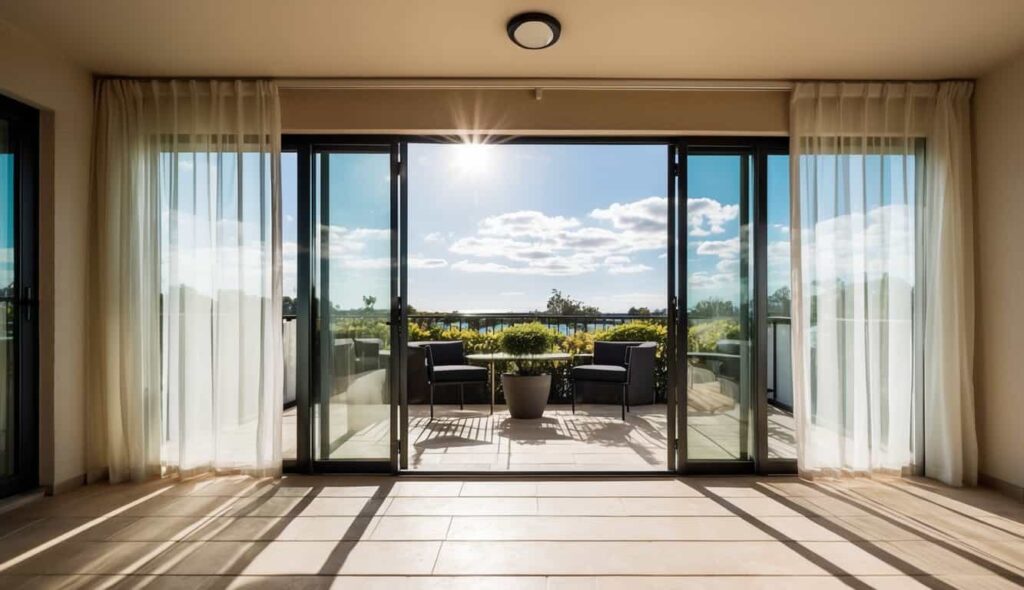
Is Your Patio Door Summer-Ready? Prevent Heat & Air Loss
Summer brings longer days, brighter light, and a more relaxed lifestyle—but it also brings one hidden challenge many homeowners overlook: heat gain through poorly sealed patio doors. What seems like a simple sliding door can actually become one of the biggest sources of energy loss in your home.
That’s why checking your patio door before peak summer heat is not just a maintenance task—it’s a comfort upgrade. Many homeowners who work with M&T Glass quickly realize how much difference a properly sealed, well-insulated patio door makes in keeping indoor temperatures stable and energy bills under control.
Let’s go deeper into the key areas you should inspect and improve before summer fully arrives.
Covered Points:
- Check for Hidden Air Leaks Around the Frame
- Inspect Weather Stripping Condition
- Evaluate Glass Performance (Single vs Double Pane)
- Test Door Alignment and Sliding Smoothness
- Look for Condensation or Moisture Between Glass Panels
- Check Frame Material and Overall Condition
- Upgrade for Energy Efficiency if Your Door Is Old
- Bonus Tip: Don’t Ignore Small Drafts
1. Check for Hidden Air Leaks Around the Frame
Air leaks are one of the most silent but damaging issues in any home. Even a perfectly clean and modern-looking patio door can hide small gaps around its frame that allow outdoor heat to enter and cool air to escape.
These leaks often go unnoticed until summer hits hard, but the signs are usually there:
- You feel a warm breeze near the edges of the door
- Your air conditioner runs longer than usual without cooling properly
- Certain rooms near the patio feel warmer than the rest of the house
What makes this worse is that even a tiny gap can create constant air exchange, forcing your cooling system to work overtime. Over a full summer season, this results in noticeable energy waste and higher utility bills.
Sealing these leaks properly ensures your home stays cooler with less effort from your AC system.
2. Inspect Weather Stripping Condition
Weather stripping might look like a small detail, but it plays a huge role in keeping your patio door energy-efficient. It acts as a flexible barrier that blocks outdoor air, dust, and humidity from entering your home.
However, over time, exposure to heat, sunlight, and repeated door movement can cause it to wear out. You may notice:
- Cracking or peeling along the edges
- Flattened rubber that no longer springs back
- Loose sections that don’t stick properly
Once weather stripping weakens, your patio door loses its ability to seal tightly. This allows hot summer air to seep in continuously.
Replacing it is a simple upgrade, but it makes a noticeable difference in maintaining indoor comfort and reducing energy loss.
3. Evaluate Glass Performance (Single vs Double Pane)
Glass quality is one of the biggest factors affecting summer comfort. Older patio doors often rely on single-pane glass, which offers very limited insulation. That means heat passes through easily, making your living space warmer even when the door is closed.
Modern solutions, however, are designed for efficiency:
- Double-pane glass traps insulating air between layers
- Low-E coatings reflect heat away from your home
- Argon gas fills improve thermal performance even further
If your patio door has outdated glass, you may notice stronger sunlight heating your floors, furniture fading faster, or uneven room temperatures during the day.
Upgrading to energy-efficient glass improves comfort instantly and reduces strain on your cooling system throughout the season.
4. Test Door Alignment and Sliding Smoothness
A patio door should glide smoothly with minimal effort. If it feels heavy, uneven, or gets stuck, it’s often a sign of alignment issues within the track or frame.
Misalignment can lead to:
- Small gaps forming along the edges
- Uneven pressure on seals and weather stripping
- Increased wear on rollers and tracks
Over time, this doesn’t just affect convenience—it directly impacts insulation. Even a slightly misaligned door can break the seal enough to allow heat transfer.
Regular adjustment and maintenance keep the door functioning properly and ensure that it continues to block unwanted outdoor heat effectively.
5. Look for Condensation or Moisture Between Glass Panels
One of the clearest warning signs of patio door failure is condensation trapped between glass panes. This usually means the internal seal has broken, allowing moisture to enter the insulated space.
When this happens:
- The insulating gas inside the glass escapes
- Moisture builds up between layers
- The glass loses its energy efficiency
This issue doesn’t just affect appearance—it significantly reduces the door’s ability to block heat. Once the seal is broken, the glass unit cannot perform as intended.
In most cases, replacement is the only long-term solution to restore proper insulation.
6. Check Frame Material and Overall Condition
The frame is the structural foundation of your patio door, and its condition directly affects performance. Different materials respond differently to seasonal heat changes.
Common issues include:
- Vinyl frames that soften or warp under intense heat
- Aluminum frames that conduct heat easily if not thermally broken
- Wooden frames that expand, crack, or absorb moisture over time
Even if your glass is high quality, a weak frame can compromise the entire system. Gaps may form, seals may loosen, and overall efficiency drops.
A properly maintained frame ensures that your patio door remains stable, secure, and energy-efficient during peak summer conditions.
7. Upgrade for Energy Efficiency if Your Door Is Old
If your patio door is over 15–20 years old, it likely doesn’t meet modern insulation standards. Technology in glass, framing, and sealing has improved significantly over the years.
Older doors often struggle with:
- Poor insulation performance
- Weak sealing systems
- Lack of UV protection
- Higher heat transfer rates
Modern patio doors offer a major upgrade:
- Multi-layer insulation systems
- Stronger sealing technology
- Better noise reduction
- Improved temperature stability
Many homeowners choose professional installation through experts like M&T Glass because correct installation is just as important as the product itself. A well-installed door performs better, lasts longer, and maximizes energy savings.
Bonus Tip: Don’t Ignore Small Drafts
Small drafts are easy to ignore, but they often signal early-stage energy loss. If you feel even slight airflow near your patio door, it means the seal is not fully tight.
Fixing small drafts early:
- Prevents bigger insulation problems
- Reduces long-term energy waste
- Improves indoor comfort immediately
Ignoring them only makes the issue worse over time.
A patio door might seem like a simple part of your home, but it plays a major role in controlling heat, air flow, and energy efficiency during summer. From air leaks and worn weather stripping to outdated glass and frame issues, even small problems can impact your comfort and energy bills. Taking time to inspect and improve your patio door ensures your home stays cooler, more efficient, and more comfortable throughout the hottest months. And when it comes to reliable upgrades and professional installation, choosing experts like M&T Glass can make a real difference in long-term performance and energy savings. A summer-ready patio door isn’t just a home improvement—it’s a smart step toward better comfort, lower costs, and a more efficient home overall.